So how good does my polar alignment really need to be?
I have written a fair bit about setting up apps for polar alignment, polar aligning with PS Align Pro, and all the things that can mess it up (smart watches, I am looking at you). But one question keeps coming up that I have never really answered properly: "How accurate does my polar alignment actually need to be?" If you have ever spent twenty minutes in the cold trying to get the cross hairs on your phone aligned perfectly with the celestial pole (or looking through a polar scope), you have probably wondered the same thing. I am a scientist by training, so I couldn't help working it out properly.
The short answer is that it depends on your lens and how long your exposures are. The good news is for a lot of wide field astro-landscape work it is probably a lot less critical than you think.
For those not willing to read a long post a quick summary of my experience is;
For wide lenses (14–35mm) and exposures up to a couple of minutes, don't stress you only need to be within about 1 degree of the celestial pole. A phone app like PS Align Pro, PhotoPills or SkySafari in a decent holder (or a laser alignment with Polaris if you are in the northern hemisphere) will easily get you well inside a degree, which is about the width of two full Moons. This holds true as well for 50mm lenses for 30 second to 1 minute exposures as well. Go and enjoy the night sky instead of fiddling.
At 50–100mm you need to take a bit more care, you need to be closer to 0.5 degree accuracy. A careful phone alignment using an app like Polar Scope Align Pro (using single star calibration) or a polar scope, will get you there for a 30 or 60 second exposure (sometimes up to 5 minutes with a 50 mm lens). Make sure the tripod is level first and keep the camera and lens away from the phone while you align. Modern lenses with focus and stabilisation motors can swing a compass a long way.
For longer lenses or exposures you are into plate solving territory. Tools like an ASIAIR, NINA or SharpCap, or old school drift alignment. A phone compass just isn't that accurate, however carefully you hold and calibrate it.
For the brave amongst you, here is a bit more detail.
First, what does a degree actually look like?
We throw around degrees, arc minutes and arc seconds a lot in astrophotography, but it's hard to picture what they mean in the sky. The easiest yardstick is the full Moon. It's about half a degree across, or roughly 31 arc minutes. The exact size shifts a little between about 29.5 and 33.5 arc minutes, depending on how close the Moon is to us.
So as a rough guide:
- 1 degree is about two full Moons side by side.
- 1 arc minute (1/60th of a degree) is about 1/30th of the width of the full Moon.
- 1 arc second (1/60th of an arc minute) is tiny. It's around 1/1800th of the Moon's width.
Another useful reference for those in the northern hemisphere is that Polaris is about 0.6 (a little more than one full moon) away from the northern celestial pole, more on that later.
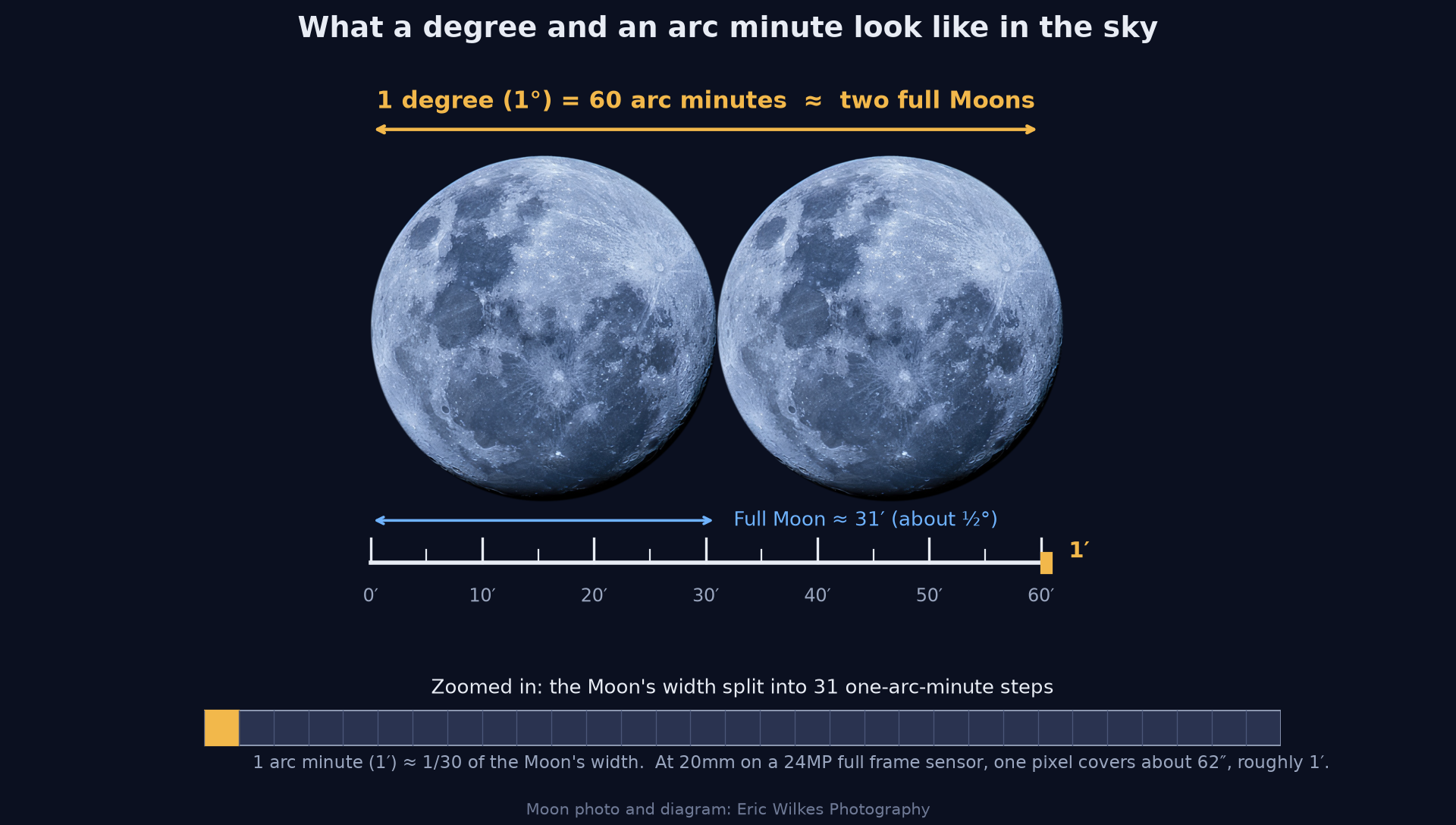
Figure 1. Two full Moons side by side span about one degree. Each disc is scaled to its real width of about 31 arc minutes, and one arc minute is roughly 1/30th of the Moon's width.
Keep the Moon in mind as you read the tables below. It makes the numbers a lot easier to picture. There's also a neat coincidence here. At 20mm on a 24 megapixel full frame sensor, each pixel covers about 62 arc seconds of sky. That's roughly one arc minute, so the Moon would be only about 30 pixels across.
A little bit of maths (I promise it is not too painful)
First we need to know how much sky each pixel on the sensor actually sees. For a typical 24 megapixel full frame sensor (6000 x 4000 pixels on a 36mm wide sensor) each pixel is about 6 microns across. The amount of sky each pixel covers is:
Image scale (arc seconds per pixel) = 206,265 x pixel size (mm) / focal length (mm)
So for my go to astro lens, the Canon RF 20mm f/1.4L VCM, that works out to about 62 arc seconds per pixel. That is a big chunk of sky for each pixel, and it's the main reason wide lenses are so forgiving.
Next we need to know what polar alignment error does. If the tracker's axis is not exactly parallel with the earth's axis, the stars slowly drift across the sensor even while the tracker is running. The drift works out to roughly:
Drift = alignment error x 2π x exposure time / 1436 minutes
The 1436 minutes is one sidereal day, the time it takes the earth to spin once relative to the stars. For a one minute exposure this means the stars drift by about 0.44% of your alignment error. That doesn't sound like much, and at 20mm it isn't.
If we want the stars to drift less than one pixel during a one minute exposure at 20mm, we can be out by nearly 4 degrees. Yes, degrees, not arc minutes. That's about eight full Moons. If we want to be a bit fussier and keep it to half a pixel for nice tight stars, that comes down to about 2 degrees, or around four full Moons.
The Polaris test
Another good reference is Polaris itself. Our northern hemisphere friends have it easier with a handy bright star sitting near the pole which they can point a laser at or spot through a polar scope (we get Sigma Octantis, which is a lot harder to find). But Polaris isn't actually on the north celestial pole. In late 2026 it sits about 38 arc minutes (0.63 degrees) away. That's a bit more than the width of a full Moon.
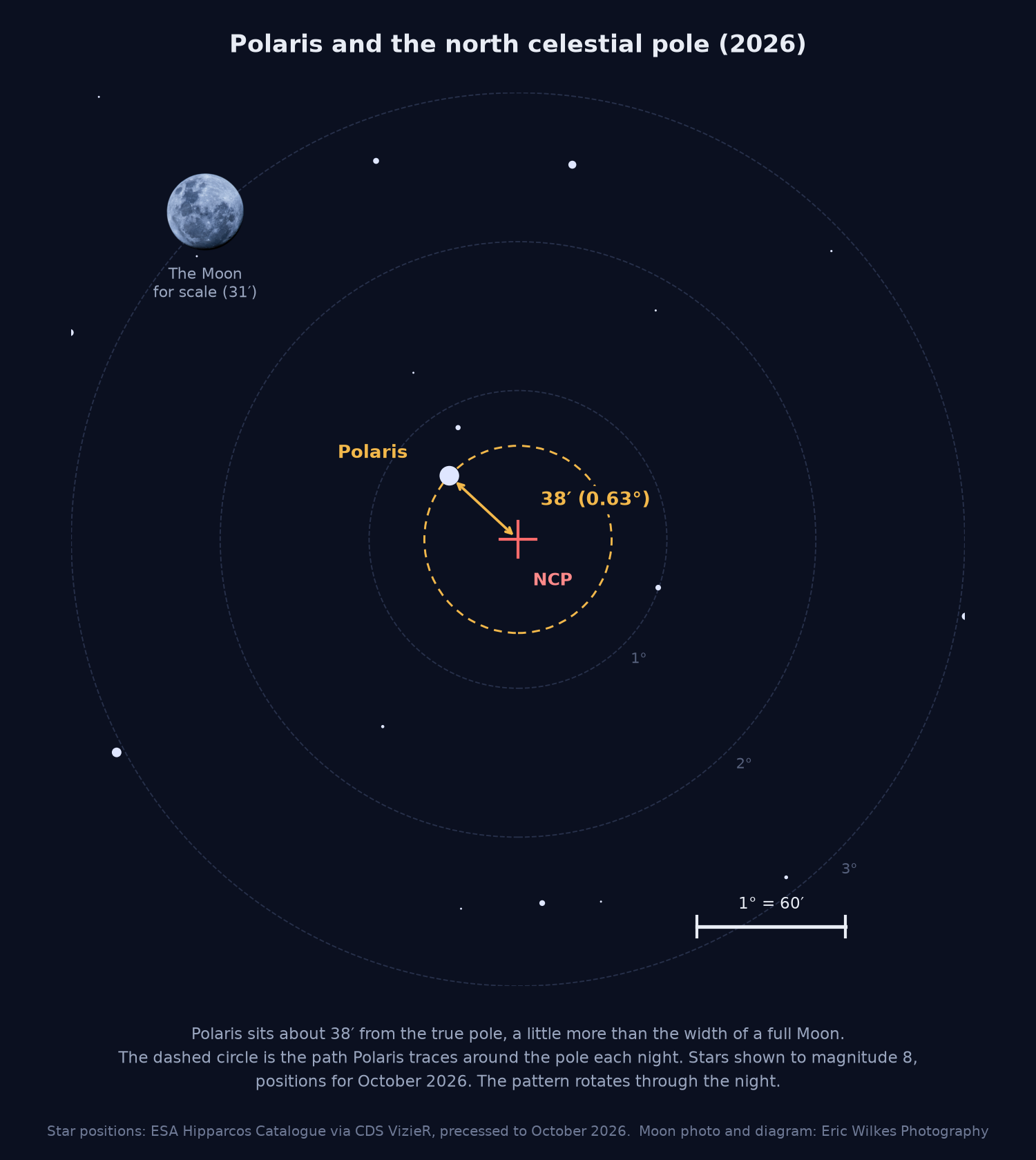
Figure 2. Polaris sits about 38 arc minutes (0.63°) from the north celestial pole, a little more than the Moon's width. The dashed circle is the path Polaris traces around the pole each night. Star positions: ESA Hipparcos Catalogue via CDS VizieR, precessed to October 2026.
This gives us a nice real world example. If you simply pointed your tracker straight at Polaris and didn't allow for the offset, you would be out by about two thirds of a degree. So how bad is that? Looking at the tables below:
- At 14–20mm it's comfortably inside the limits, even for two minute exposures. Pointing roughly at Polaris would be absolutely fine.
- At 35–50mm it's fine for 30 to 60 second exposures. At two minutes the stars start to stretch.
- At 100mm you can just get away with it at 30 seconds, but not much longer.
- At 200mm that error would trail your stars even at 30 seconds.
At the longer focal lengths you really do need to allow for the offset. That is exactly what the reticle in a polar scope and apps like PS Align Pro are for.
So the difference between Polaris and the true pole is a really handy mental benchmark. If your alignment is "about as good as pointing at Polaris", you are fine for wide field work but not for telephoto.
And for those of us down south, here is the equivalent view of our pole. Sigma Octantis is our "pole star", but it's a lot fainter than Polaris (magnitude 5.5, so you need a dark sky and good eyes). It's also further from the pole, at about 69 arc minutes (1.15 degrees), or more than two Moon widths. Most people find it using the little trapezoid it makes with Chi, Tau and Upsilon Octantis.
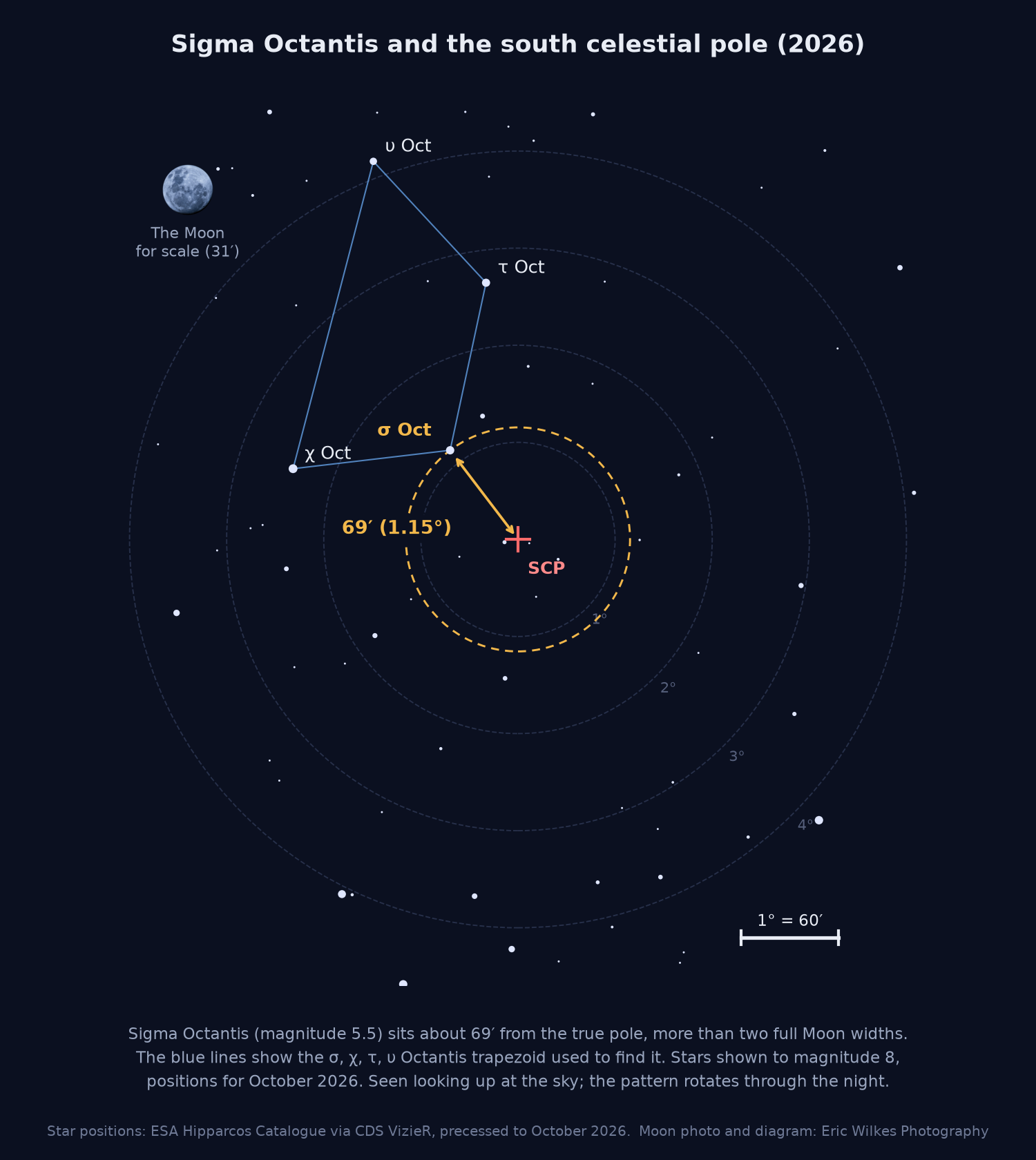
Figure 3. Sigma Octantis sits about 69 arc minutes (1.15°) from the south celestial pole, more than two Moon widths. The blue lines show the Sigma, Chi, Tau and Upsilon Octantis trapezoid used to find it. Star positions: ESA Hipparcos Catalogue via CDS VizieR, precessed to October 2026.
So if you pointed straight at Sigma Octantis and ignored the offset, you'd be out by over a degree. That is fine at 14mm or 20mm for a minute or so, but not much beyond that.
So what about other lenses?
This is where it gets interesting. The allowable error goes down as focal length goes up, and it also goes down as exposure time goes up. Double either one and you halve how far out you can be.
Here are the numbers for a one minute exposure on a 24 megapixel full frame camera. For comparison, remember the full Moon is about 0.5° (31′) across. Polaris is about 0.63° (38′) from the north celestial pole, and Sigma Octantis is about 1.15° (69′) from the south celestial pole.
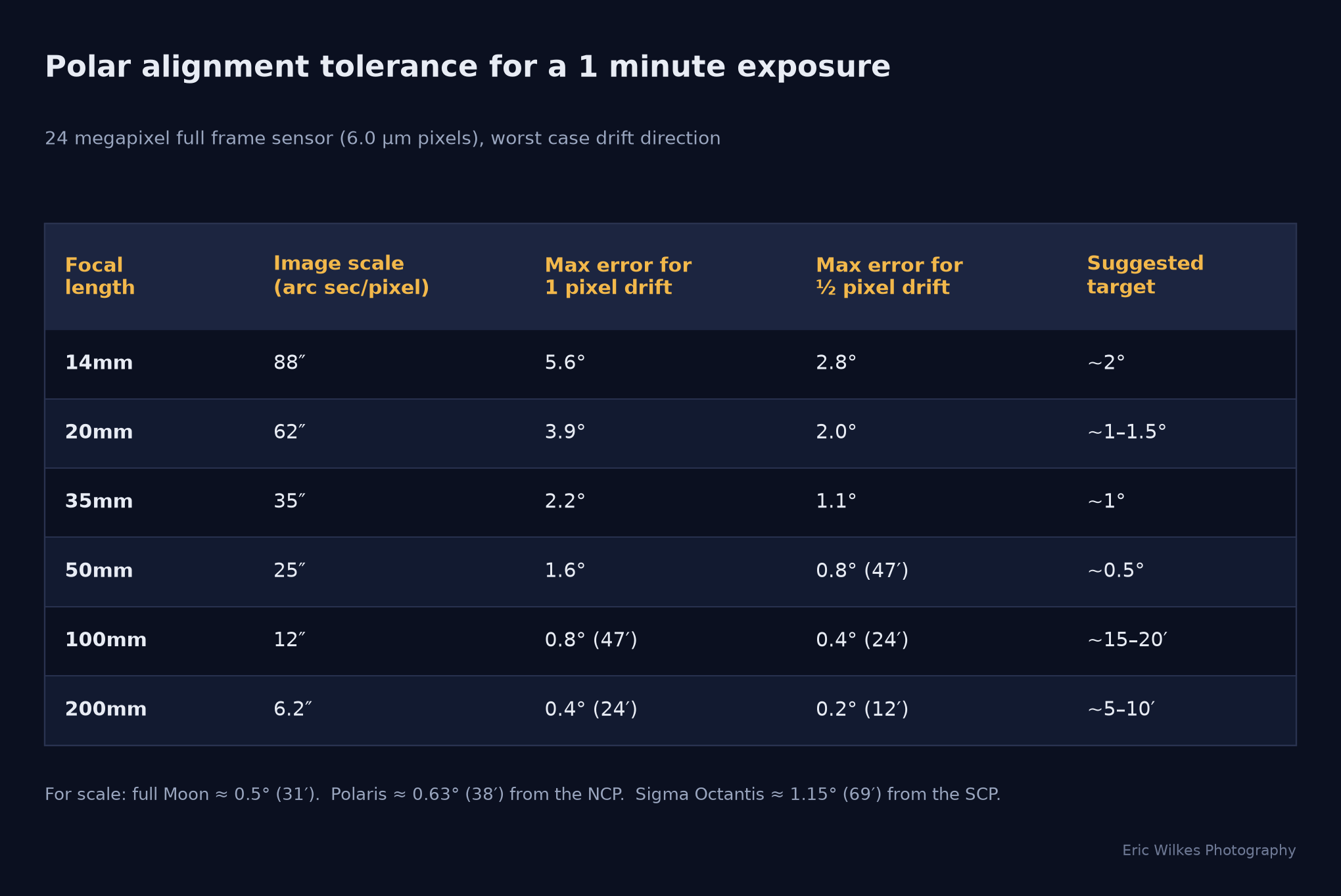
The suggested target leaves a bit of margin. Things are never quite as perfect in the field as they are on paper.
And for different exposure times
Most of us don't just shoot one minute exposures, so here are the suggested targets across a range of exposure times. The number in brackets is the maximum error that still keeps drift under half a pixel.
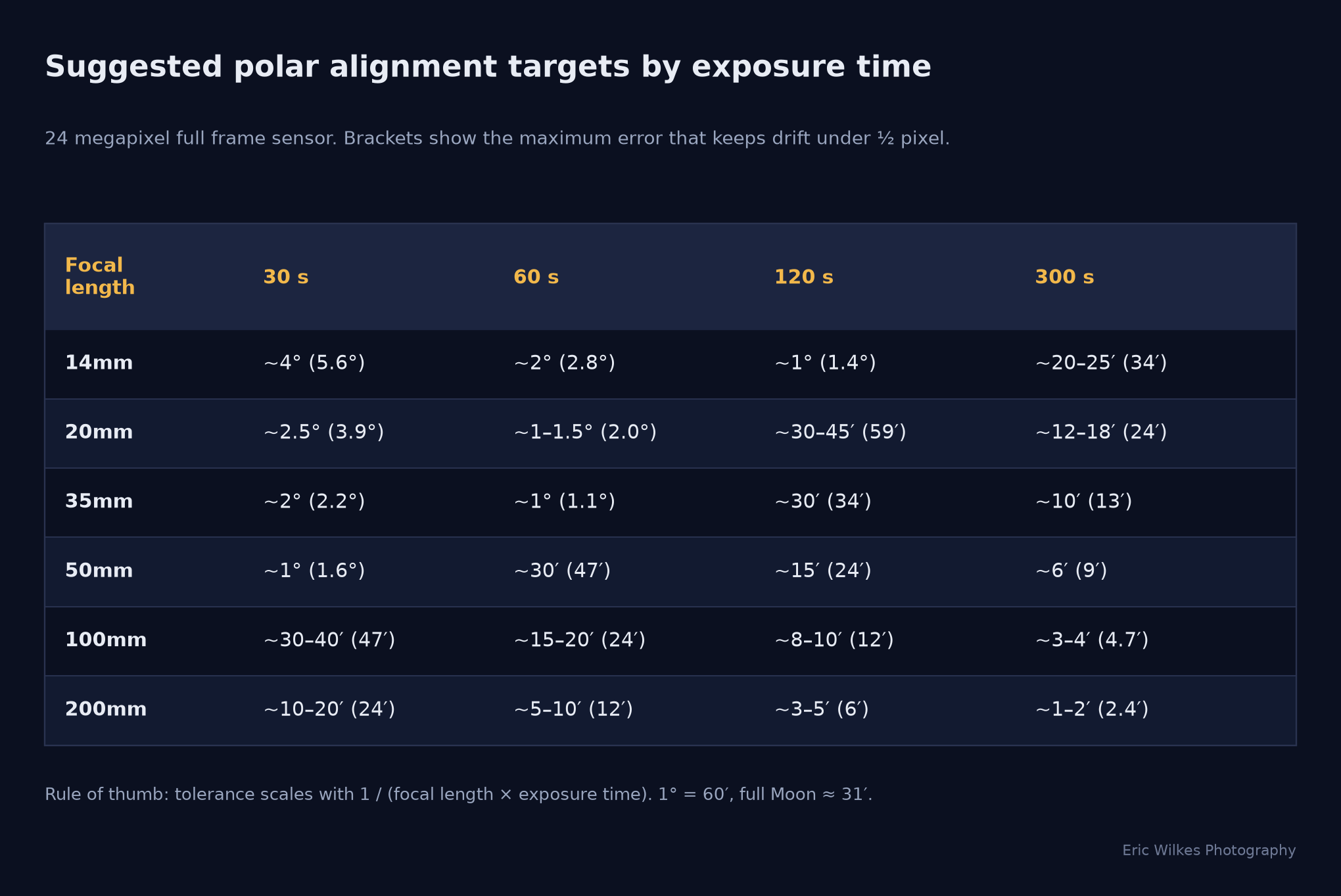
A handy rule of thumb is that what matters is focal length multiplied by exposure time. So 100mm for 30 seconds needs the same accuracy as 50mm for 60 seconds.
So what does this mean out in the field?
A few things I take from this:
1. For wide lenses (14–35mm) and exposures up to a couple of minutes, don't stress. A phone app like PS Align Pro or SkySafari in a decent holder will easily get you well inside a degree, which is about two full Moons. That is more than good enough, and at 14–20mm even "Polaris level" accuracy would do the job. Go and enjoy the night sky instead of fiddling.
2. At 50–100mm you need to take a bit more care. A careful phone alignment or a polar scope, done properly with the right hour angle, will get you there for shorter exposures. Make sure the tripod is level first and keep the camera and lens away from the phone while you align. Modern lenses with focus and stabilisation motors can swing a compass a long way.
3. For longer lenses or exposures (below about 5 arc minutes requirements, about a sixth of the Moon's width) you are into plate solving territory. Tools like an ASIAIR, NINA or SharpCap, or old school drift alignment. A phone compass just isn't that accurate, however carefully you hold and calibrate it.
4. At longer focal lengths polar alignment stops being the main problem. At 200mm and beyond, the periodic error in the tracker's worm gear, balance, flex and a bit of wind will usually trail your stars long before a small alignment error does. Most small trackers struggle to hold 6 arc seconds per pixel for a minute or more without guiding, no matter how perfectly they are aligned.
There is one more little catch. Polar alignment error doesn't only cause drift, it also causes a slight rotation of the field around the point the tracker is following. It's usually small, but it is worst in the corners of the frame and when you are pointing close to the celestial pole. That is a big part of why the suggested targets are a bit tighter than the calculated limits. Down here in the southern hemisphere we point south towards the pole quite a lot, so it's worth keeping in mind.
Another thing to consider is if you are using a camera with a higher pixel count (and hence smaller individual sensor sites) the required accuracy to stay at 0.5 pixel drift is greater. However in the real world of posting things on social media this make very little difference except in seriously cropped images.
How good are the phone alignment apps?
Using apps like Stellarium, SkySafari Pro, PhotoPills or Steve Barnes Simple Polar Align and taking into account magnetic interferences it is quite easy to get within 1 degree of the celestial pole. In my experience that gives great results for 1 minute exposures with lenses up to 50mm. Using Polar Scope Align Pro and single star calibration it is easy to get better than 0.5 degree accuracy for a 5 minute exposure at 20 and 50 mm.
A quick caveat though, some phones (particularly android ones) can drift very quickly from their calibration so results can vary. If you are seeing the target drift as you do the alignment it is usually not the app, but rather the phone or the environment. The general rule is to calibrate the phone and the alignment as quick as possible.
And that is about it
For most of us shooting astro-landscapes on a tracker with wide lenses, "close enough" really is close enough. Careful alignment with a phone app can give you great results (as long you remember to take into account the things that can stuff it up!). If your stars are trailing at 20mm on a one minute exposure, the problem is probably not your polar alignment. Check your balance, make sure the nothing is slipping and the tracker is actually turned on (don't ask how I know).
Ground breaking science, nah. But hopefully it saves someone a few cold minutes chasing arc minutes they don't need.
Hope this has been useful and as always let me know if there are any suggestions. Please share this with anyone who asks, a little knowledge goes a long way.
Clear Skies
Eric
If you appreciate my efforts doing the research for these kind of blogs, please consider buying me a cup of coffee at this link. No pressure, I just need to keep my caffein addicition fed 😎.