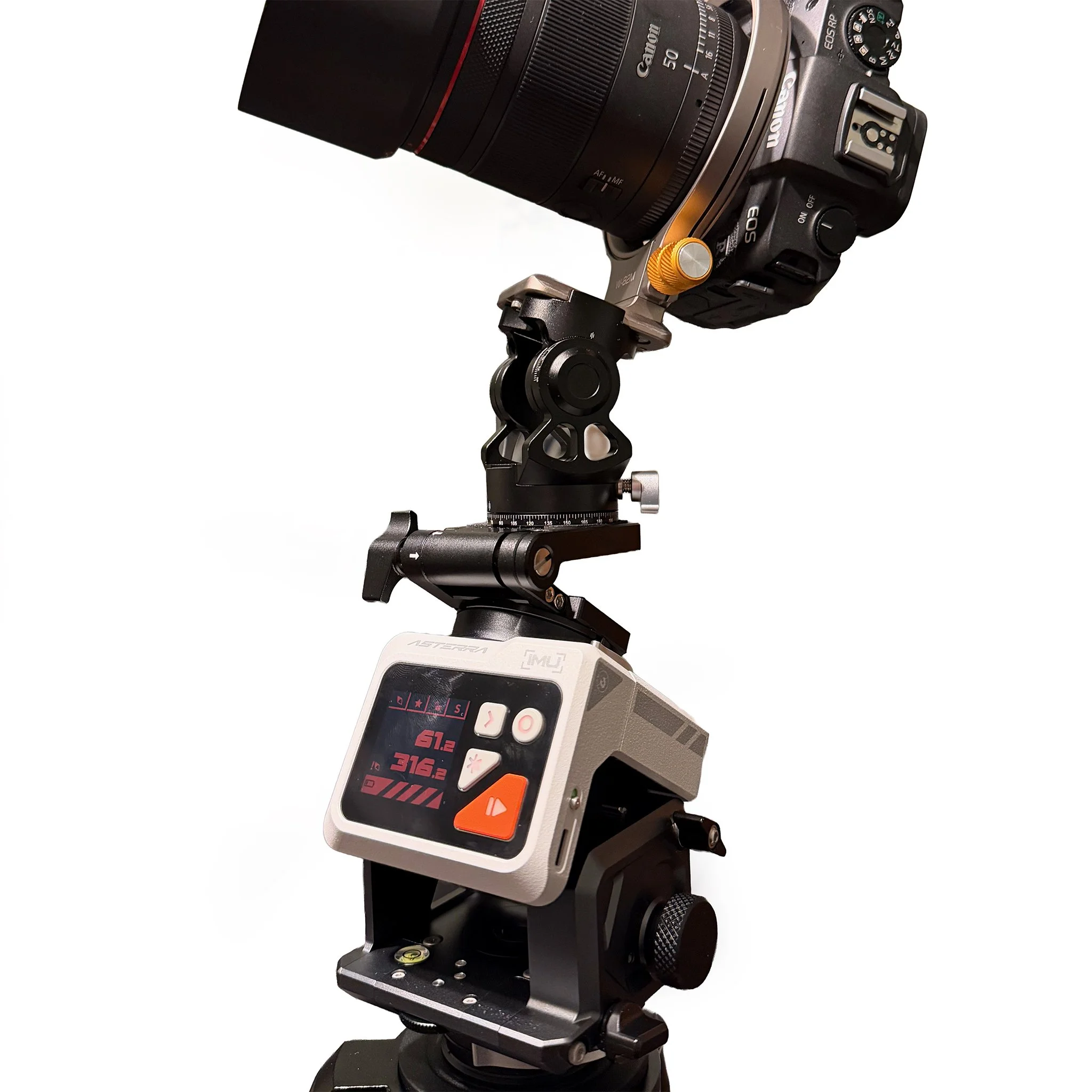
The video review I have done is linked at the bottom of the post, but I suggest having a read of the below first.
I couldn’t help but notice the social media barrage that Asterra had launched to get this new tracker noticed and it caught my interest. So I bought one to try (I am honestly still justifying it to my wife) and hopefully share my experiences with others to make it easier to decide if it is worth it.
My first short reaction is no, it really does not offer any really significant advantage if you already have a Nomad or similar and a decent process for Polar aligning. The inbuilt compass is magnetic and suffers from all the same influences as the one in your phone (check out some of my earlier blogs) But, unlike your phone (at least, most phones), it only shows magnetic North so to get a decent polar alignment you need to look up your local magnetic declination and make that adjustment as well. This means in the southern hemisphere it does not offer much in the way of advantage.
It does have a built in aligned laser which means in the parts of the Northern Hemisphere where laser use is allowed it is one less thing you need to take with you and should make it easy to align with Polaris, so that is definitely in its favour. It also has partnered with the PlanIt pro app to offer single star alignment for even more accuracy or use in places where Polaris is not visible. This, however, still requires the use of the laser so rules it out in many places again.
The integral wedge is a really nice touch and is very well executed, it was a pleasure to use. However in recent times I have taken to just using a lightweight geared head on my tripod as a wedge and for my day to day photography so that does not make any real difference to my process for astro (it actually adds a step since I have to take it off to use the Asterra Z+). I do really like the implementation of the v-plate they have, hopefully other manufacturers take some hints from it. But it is dedicated to this mount with a custom quick release mount so it can’t be used for anything else.
It also does give the option of working off either 3 AA batteries or a USB C powerbank (it does not come with any internal rechargeable battery) which is nice and means that it won’t suffer from the dreaded battery replacement issues as it gets older. It does seem to drain its AA batteries quite quickly, but I am sure you would get an easy nights use out of them. I have not had a chance to properly tested this yet.
I also found the documentation to be a little bit lacking, my unit had a warning symbol at times on the front panel that appears nowhere in the manual and a request to email support has not got a reply 4 days later. It didn’t seem to impact the operation and was not there all the time, but it would be nice to know what it was telling me. Also there is nothing in the manual about how you can calibrate the compass, something that I found was absolutely necessary to get a reasonable reading. Luckily a friend in the US had had similar issues and support had got back to him with a response and he passed on the instructions which resolved the issue (in case you are reading and wondering, you press the laser button for 7 seconds and then slowly rotate the unit through all 3 axes in turn until you get a good indication on the front screen and then press the laser button again, obvious really). But I should not be too harsh as this is a brand new release tracker and I am sure later editions of the manual (and the website hopefully) will have better information.
So is it worth $749 US (the current discounted price for the version with the v-plate). Probably depends how important having it all built into one unit and with a nice digital display is to you personaly. To get the equivalent with a Nomad from MSM is around $409 US (Nomad, Wedge, v-plate, panning base and phone holder, if you are in the northern hemisphere you can swap the phone holder for a laser, same price). If you already have a geared head you can drop off $90 from that so overall the nomad is really only about half the cost. Yes you need a smart phone in the southern hemisphere for PA, but I think most people doing this kind of photography are likely to have one of those on them out in the field. And using a phone with the latest app from Polar Scope Align Pro you can get a much more accurate alighnment and longer tracking (check out my previous blog) than you can get with this unit without laser alignment.
So, at least in the Southern hemisphere, I am not sure it is a great value proposition. Don’t get me wrong, it does work. I am just not sure it is worth the extra cost for essentially the same capabilities (and space in my bag, always a consideration). Below I will put a link to the YouTube video I did giving my first impressions of the unit and show how I did get good 2 minute tracks with a 50 mm lens as long as I knew the local magnetic declination and compensated for it. Give it a watch (and a like and subscribe) if you want to see my first impressions of using it in the field on a very cold winters night in South Australia.
If you appreciate my efforts testing this kind of gear and writing about it, please consider buying me a cup of coffee at this link. Other than that, clear skies and does anyone want to buy a slightly used star tracker 😎.